Showing posts with label birds. Show all posts

Tuesday, June 5, 2012

Great Horned Owl

Great Horned Owl nesting in clay bank along the Columbia River.
Photo and Video by Randy Hopkins.


Great Horned Owls are found throughout BC and according to Birds of British Columbia most nest sites are in trees where the owl uses old nest from other birds like Red-tailed Hawks, Bald Eagles, Crows and Great Blue Herons. Sometimes they will nest on top of a broken snag and occasionally they use a hole in a clay bank like this one along the Columbia River.

Monday, April 2, 2012

Canada Geese Pairing UP

Canada Goose displaying it’s alert, wary of danger body language - Photo by Larry Halverson

The Canada geese have started  “pairing up” for nesting. And the Columbia Valley is sounding quite musical with lots of  “honk-a-lonk” filling the air. If you listen closely you can distinguish between the male’s lower “honk” and the female’s higher “hink’.

Tuesday, February 14, 2012

Making Tracks

Mule Deer & Wild Turkey photo by Larry Halverson
So often you only see the tracks left by animals. But here is a picture of a Mule Deer and a Wild Turkey caught in the act of making tracks in the fresh snow on Valentine's Day

Saturday, August 13, 2011

Fall Migration Has Begun

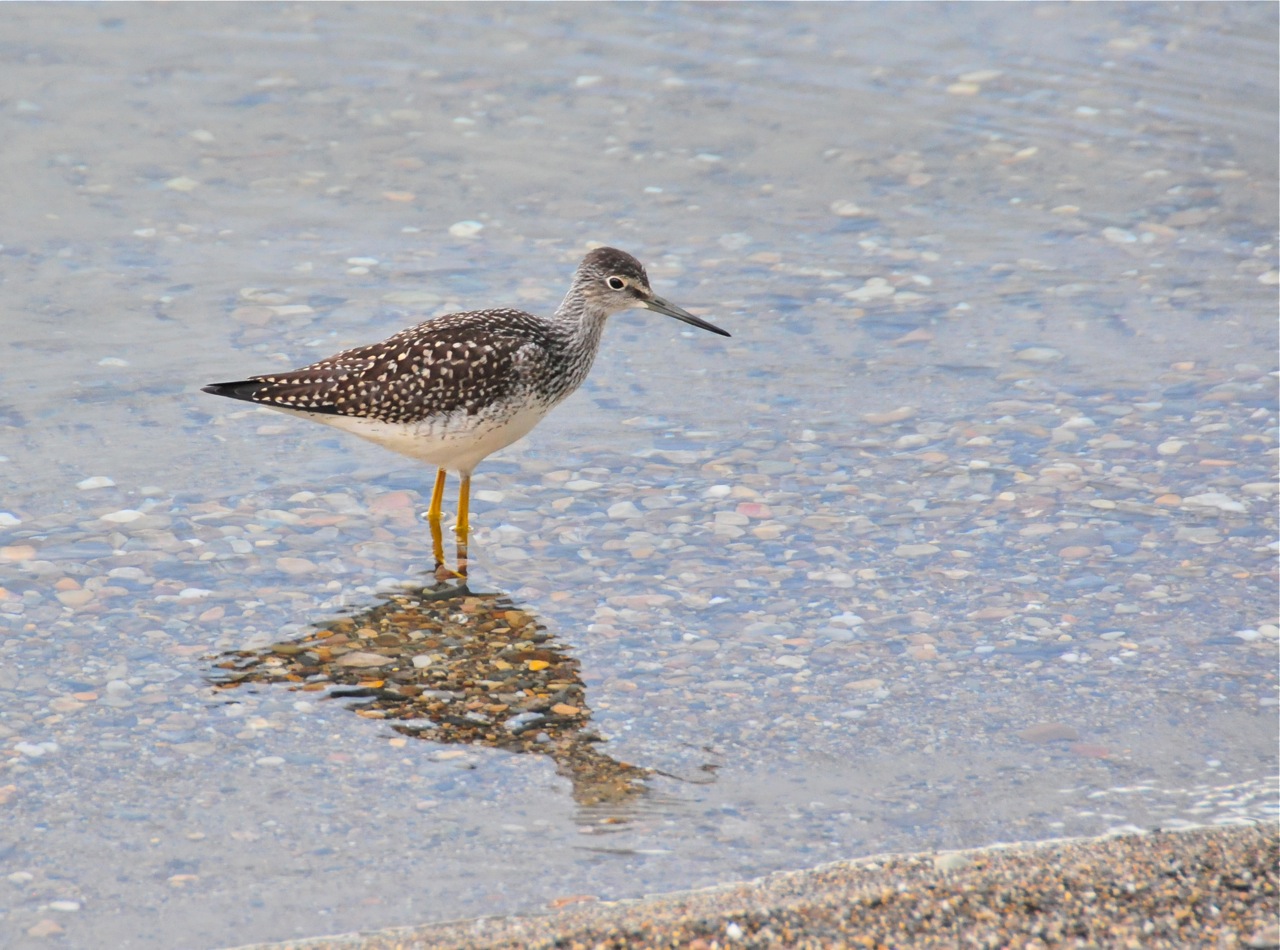
 Greater Yellowlegs feeding on the shore of Lake Windermere,
July 29th , 2011    Photo by Larry Halverson
Greater Yellowlegs are one of the early migrants  passing through the Columbia Valley. Leaving their subarctic breeding grounds they’ll feed on small aquatic and terrestrial invertebrates, small fish, frogs, in wetlands as they move to their winter grounds in southern USA and South America. The autumn movement through our area peaks from mid August till September.

Monday, May 23, 2011

British Columbia Breeding Bird Atlas

Christopher Di Corrado, Atlas Coordinator recording birds in the 
Columbia Wetlands - Photo by Larry Halverson


The British Columbia Breeding Bird Atlas (2008-12) is large-scale wildlife monitoring projects that engages over 1000 volunteers to map the distribution and abundance of breeding birds across the province. In 2011, we enter the fourth season of the atlas. So far over 240,000 records have been gathered during more than 30,000 field hours. The large, electronic datasets, freely available from NatureCounts, and maps and summary products available in near real time (www.birdatlas.bc.ca), have made the atlas a powerful tool for immediate conservation application, and for measuring  long-term change at local to landscape scales.

To get involved contact the regional coordinators:
Golden  - Ellen Zimmerman region28@birdatlas.bc.ca
Invermere  -  Cam Gillies or Larry Halverson region02@birdatlas.bc.ca


Wednesday, March 2, 2011

Chickadee Love Song

Black-capped Chickadees in the Columbia Valley 
have already been heard singing their love song


Most everyone can identify the bird that sings a rapid, nasal Chickadee-dee-dee. It is the call the Chickadee uses to challenge intruder or to express alarm and it can be heard anytime during the year. However in April, which is the beginning of the courtship season, the Chickadee adds a less familiar tune to its vocabulary. It sings a sweet two-toned whistle of two or three notes, the first being higher and longer than the last one or two. This "love song" sounds like feee-bee or if you listen closer to lunchtime it sounds more like cheezzee-burger. The song can be heard from now until the early part of the nesting season. It is a delightful ditty, which means spring is here.